Grounding Conductor Size Chart: EGC vs GEC (NEC 2023)
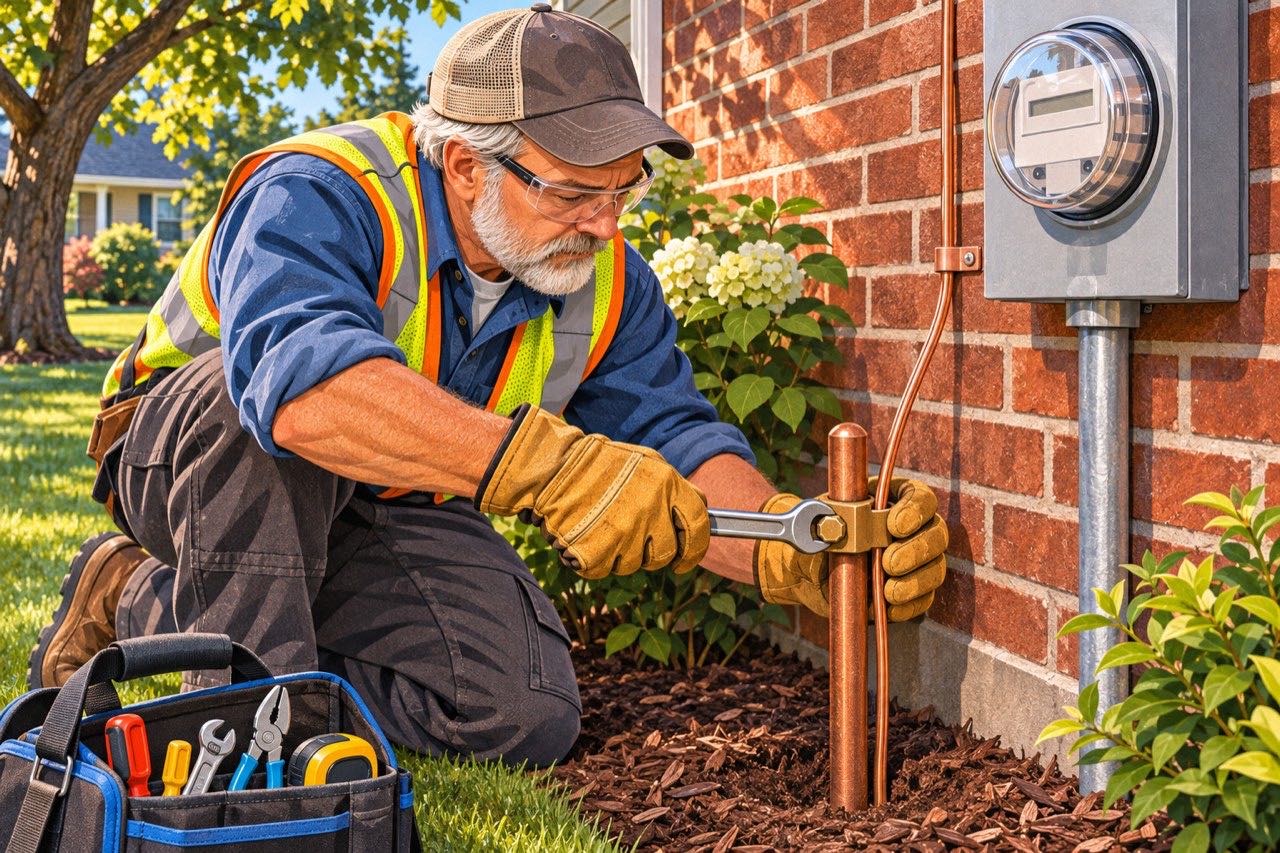
A grounding conductor size chart is really two NEC tables. Size an equipment grounding conductor (EGC) from Table 250.122 using the rating of the breaker or fuse ahead of the circuit, and size a grounding electrode conductor (GEC) from Table 250.66 using the size of the largest service-entrance conductor. A 20 A circuit gets a 12 AWG copper EGC; a service on 3/0 copper gets a 4 AWG copper GEC.
Key takeaways
- EGC: Table 250.122, read by the overcurrent device rating (60 A → 10 AWG Cu, 100 A → 8 AWG, 200 A → 6 AWG).
- GEC: Table 250.66, read by the largest ungrounded service-entrance conductor.
- Upsize the circuit wires and the EGC grows by the same circular-mil ratio (250.122(B)).
- A GEC that runs only to rods, pipes or plates never has to exceed 6 AWG copper (250.66(A)).
- A GEC that runs only to a concrete-encased electrode never has to exceed 4 AWG copper (250.66(B)).
What is the difference between an EGC and a GEC?
The equipment grounding conductor runs with the circuit, from the panel to the metal parts of the equipment it feeds. Its job is to give fault current a low-impedance path back to the source so the breaker trips fast. That is why it is sized from the breaker.
The grounding electrode conductor runs from the service (or a separately derived system) to the grounding electrode: a rod, a concrete-encased electrode, a water pipe, a ground ring. It ties the electrical system to the earth. That is why it is sized from the service conductors, not from a breaker.
On the exam, the first move is always to decide which conductor the question is about. Pick the wrong table and every number after that is wrong, no matter how careful the math.
How do you size an equipment grounding conductor?
Find the rating of the overcurrent device protecting the circuit, then read the copper (or aluminum) column of Table 250.122. Each row covers ratings up to and including its value, so a 30, 40 or 50 A breaker all fall in the 60 A row and get a 10 AWG copper EGC. A 125 A or 150 A device falls in the 200 A row: 6 AWG copper. A 225 A device falls in the 300 A row: 4 AWG copper.
Two limits sit next to the table. The EGC never has to be larger than the circuit conductors it runs with (250.122(A)). And when circuits run in parallel in separate raceways, each raceway gets its own full-size EGC based on the overcurrent device (250.122(F)).
The table below is an excerpt of Table 250.122, copper only — see the NEC table for all ratings and the aluminum column.
| Overcurrent device, not over (A) — excerpt | Copper EGC (min.) |
|---|---|
| 15 | 14 AWG |
| 20 | 12 AWG |
| 60 | 10 AWG |
| 100 | 8 AWG |
| 200 | 6 AWG |
| 300 | 4 AWG |
| 400 | 3 AWG |
| 600 | 1 AWG |
| 800 | 1/0 AWG |
| 1,000 | 2/0 AWG |
When must the equipment grounding conductor be upsized?
If you install ungrounded conductors larger than the minimum size that has enough ampacity, usually to control voltage drop, 250.122(B) makes the wire-type EGC grow in proportion. Use the circular-mil areas from Chapter 9, Table 8.
Worked example: a 200 A feeder in copper with 75 °C terminations. The smallest conductor that carries 200 A in the 75 °C column of Table 310.16 is 3/0 AWG. The run is long, so you pull 250 kcmil instead. Table 250.122 gives a 6 AWG copper EGC for 200 A.
- Step 1 — ratio: 250,000 cmil ÷ 167,800 cmil (3/0) = 1.4899.
- Step 2 — scale the table EGC: 26,240 cmil (6 AWG) × 1.4899 = 39,094 cmil.
- Step 3 — pick the next size up in Chapter 9, Table 8: 4 AWG at 41,740 cmil (6 AWG is too small at 26,240).
- Answer: a 4 AWG copper EGC, still never larger than the 250 kcmil circuit conductors.
How do you use a grounding electrode conductor size chart?
Find the largest ungrounded service-entrance conductor, or the combined area of each phase if the service is paralleled. Read across Table 250.66 to the GEC column. The same table sizes GECs for separately derived systems, such as a transformer, from the derived phase conductors.
Worked example: a 200 A service on 3/0 copper. 3/0 falls in the 2/0–3/0 row, so the copper GEC is 4 AWG. A 400 A service on 500 kcmil copper falls in the over-350-through-600 kcmil row: 1/0 copper.
The table below is an excerpt of Table 250.66, copper to copper — see the NEC table for larger services and aluminum.
| Largest service conductor, copper — excerpt | Copper GEC (min.) |
|---|---|
| 2 AWG or smaller | 8 AWG |
| 1 or 1/0 AWG | 6 AWG |
| 2/0 or 3/0 AWG | 4 AWG |
| Over 3/0 through 350 kcmil | 2 AWG |
| Over 350 through 600 kcmil | 1/0 AWG |
Why can a GEC to a ground rod stay at 6 AWG?
Table 250.66 has three caps that exam writers love. If the GEC (or the part of it) runs only to rods, pipes or plates, it never has to be larger than 6 AWG copper (250.66(A)). If it runs only to a concrete-encased electrode, it never has to be larger than 4 AWG copper (250.66(B)). If it runs only to a ground ring, it never has to be larger than the ring conductor (250.66(C)).
The cap applies only when that conductor serves that electrode alone. Back to the 400 A service: a GEC that goes only to the rods can be 6 AWG copper, and one that goes only to the footing steel can be 4 AWG copper. If the same conductor continues to the metal water pipe, the full table size of 1/0 copper applies.
Grounding conductor sizing: quick worked examples
Notice the trap in the last line below: the table answer and the rod-only answer differ. Read the question for where the GEC ends before you commit.
- 20 A branch circuit → Table 250.122, 20 A row → 12 AWG copper EGC.
- 50 A range circuit → falls in the 60 A row → 10 AWG copper EGC.
- 225 A feeder → falls in the 300 A row → 4 AWG copper EGC.
- Service on 2 AWG copper → Table 250.66 → 8 AWG copper GEC.
- Service on 4/0 copper → over 3/0 through 350 kcmil → 2 AWG copper GEC; only to a rod → 6 AWG copper.
Where are these tables in the code book?
Both live in Article 250. The GEC rules are in Part III (250.64 for installation, 250.66 and its table for size). The EGC rules are in Part VI (250.118 for what counts as an EGC, 250.122 and its table for size). Tab both tables; they are among the most-used pages on the exam.
Do not confuse either one with Table 250.102(C)(1), which sizes the main bonding jumper and supply-side bonding jumpers from the service conductors. It looks similar, so a quick highlight on each table header saves a wrong answer.
Practice grounding questions
EGC and GEC sizing shows up on nearly every journeyman exam. Try exam-style questions with the code reference for each answer.
Take the free practice test →Questions
What size ground wire do I need for a 20 amp circuit?
A 12 AWG copper equipment grounding conductor, from the 20 A row of Table 250.122. A 15 A circuit needs 14 AWG copper.
Is the ground wire always smaller than the hot wires?
No. Table 250.122 is based on the breaker, so on small circuits the EGC is often the same size as the circuit conductors. It never has to be larger than them (250.122(A)), but it does grow if you upsize the hots (250.122(B)).
What size grounding electrode conductor for a 200 amp service?
It depends on the service conductors. On 3/0 copper, Table 250.66 gives 4 AWG copper. If the GEC runs only to ground rods, 6 AWG copper is enough under 250.66(A).
What is the minimum grounding electrode conductor size?
The smallest row of Table 250.66 is 8 AWG copper, for services of 2 AWG copper or smaller. Installation rules in 250.64 can still require protection for small GECs.
Does the equipment grounding conductor count in conduit fill?
Yes. Chapter 9, Note 3 counts equipment grounding and bonding conductors in the fill. They do not count as current-carrying conductors for ampacity adjustment.
Sources
- NFPA 70, National Electrical Code (2023 edition) — official NFPA page ↗ — Article 250: 250.64, 250.66 and Table 250.66, 250.102(C)(1), 250.118, 250.122 and Table 250.122; Chapter 9, Table 8 (2023 edition)
Updated 2026-11-27. Section references are to the 2023 NEC. Ohmward is independent exam preparation, not affiliated with NFPA, any licensing board or testing company. NEC® is a registered trademark of the NFPA.