How to Become a Journeyman Electrician: Steps and State Rules
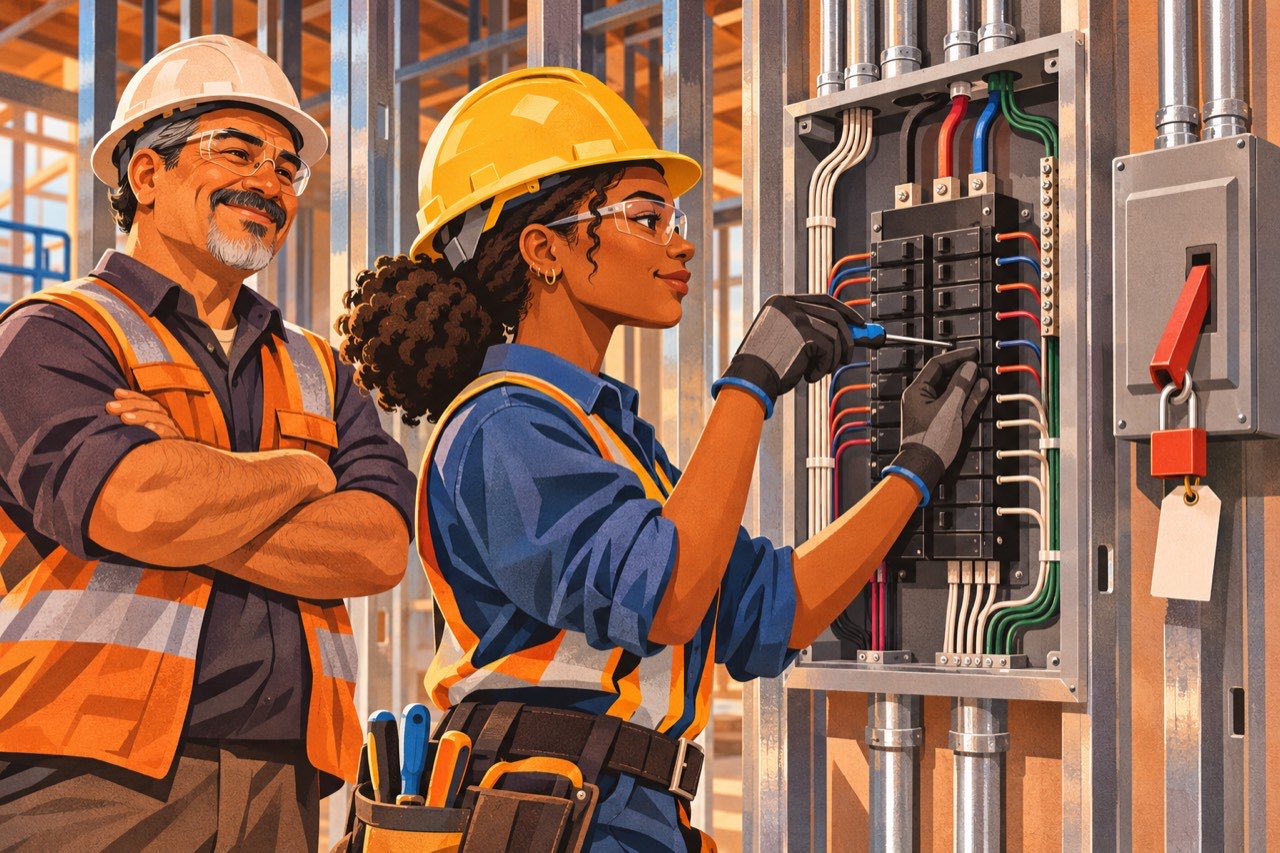
To become a journeyman electrician, you log a required amount of supervised electrical work (8,000 hours is the most common figure in state rules), usually through an apprenticeship that includes classroom training, then apply to your state licensing board and pass an exam based on the National Electrical Code. At 8,000 hours, that is about four years of full-time work. In states with no statewide journeyman license, a city or county issues it instead.
Key takeaways
- 8,000 hours of supervised work is the most common requirement; Utah and Arkansas list 16,000 hours for some routes, and Hawaii lists 10,000.
- Many states also require classroom hours, such as 288 in Colorado, 576 on Iowa's apprenticeship route, and 96 in Washington.
- You usually need board approval before you can book the exam with the testing company.
- Most state exams have 60 to 100 questions, are open book in most states, and are usually written to the 2020, 2023 or 2026 NEC depending on the state.
- Some states, including Illinois, New York and Pennsylvania, have no statewide journeyman license; licensing is local.
- Licenses must be renewed, usually with continuing education on the NEC.
What are the journeyman electrician license requirements?
If you're asking how to become a journeyman electrician, the short version is the same almost everywhere: prove you've done the work, prove you know the code, and keep the license current. The details (hours, classroom time, exam format, fees) are set by each state, and in some places by each city.
Most licensing paths follow five steps. Knowing them up front helps you keep the right paperwork from your first day as an apprentice, not scramble for it at the end.
- Experience: log supervised on-the-job hours under a licensed electrician or contractor.
- Classroom training: complete related instruction, often through a registered apprenticeship.
- Application: send your experience records to the state board and get approved to test.
- Exam: pass a timed test built on the NEC, usually with your code book open.
- Renewal: keep the license active with fees and continuing education.
How do you become an electrician, and how long does it take?
Every route to becoming an electrician works the same way: you work under a licensed electrician, log the hours, learn the code, and then pass the journeyman exam. How long that takes depends mostly on your state's hour rule.
Of the 51 jurisdictions in our state guides, 25 list exactly 8,000 hours of experience for the journeyman license. At about 2,000 hours a year of full-time work, that's roughly four years. A few ask for more: Hawaii requires 10,000 hours over five years, and Utah and Arkansas list 16,000 hours on some routes.
Apprenticeships run on the same clock. The electrical training ALLIANCE's national guidelines for inside electricians, approved by the U.S. Department of Labor in 2024, set a four-year term with 8,000 hours of on-the-job learning and at least 720 hours of classroom instruction; local programs can adjust them. IEC describes its program as about four years.
The last step is the exam. Once the board approves your hours, you test, and when you pass you're a journeyman; Texas even lets you apply at 7,000 hours and test early. Most people get to that point by one of three paths:
- Registered apprenticeship: a union program run by a local JATC (IBEW and NECA), or a non-union program such as an Independent Electrical Contractors (IEC) chapter's. You're paid to work, you attend classes, and your hours are documented for you.
- Trade school plus on-the-job hours: some states credit schooling toward the experience rule. Utah accepts 576 hours in an approved electrical program plus 6,000 apprentice hours, North Dakota credits a two-year electrical school with 2,000 hours, and Kansas lets at least 930 program hours replace up to one of its two years.
- Registered trainee or helper: you're hired by an electrical contractor, register with the state, and track your own hours. Texas requires a TDLR apprentice electrician license for this, and California has you register as an electrician trainee and enroll in a state-approved school.
| Path | Typical length | Source |
|---|---|---|
| Union apprenticeship (JATC) | 4 years: 8,000 work hours plus at least 720 classroom hours | electrical training ALLIANCE national guidelines, U.S. DOL Bulletin 2024-144 |
| Non-union apprenticeship (IEC) | About 4 years: at least 8,000 work hours plus 576 classroom hours | IEC apprenticeship FAQ |
| School plus work hours | Depends on state credit, e.g. Utah: 576 school hours plus 6,000 work hours | Utah exam bulletin |
| Trainee or helper | Your state's full requirement, most often 8,000 hours | Our state guides |
How many hours do you need to become a journeyman electrician?
In the state rules we track, 8,000 hours is by far the most common number. Several states pair it with a time minimum: Colorado wants the 8,000 hours spread over at least four years, with at least 2,000 of them in commercial or industrial work, and Michigan asks for 8,000 hours and four years as an apprentice.
Some states ask for more. Hawaii requires at least 10,000 hours over five years of full-time wiring work. Utah lists 16,000 hours as a licensed apprentice, or 576 hours in an approved electrical program plus 6,000 apprentice hours. Arkansas accepts a four-year DOL-approved apprenticeship, or 8 years (16,000 hours) of experience without one.
Texas has an early exam option: you can test after 7,000 approved hours, but the license isn't issued until all 8,000 hours are approved. Washington lets you apply for the exam along with your final experience affidavit. Track your hours by employer and type of work as you go, because many boards cap how much any one kind of work can count.
Do you need an apprenticeship to become a journeyman?
Not always, but it's the most common route, and some states build their rules around it. Iowa's usual path is a U.S. Department of Labor registered apprenticeship with 8,000 hours of on-the-job training and 576 classroom hours. Wisconsin accepts an approved construction electrician apprenticeship of at least three years, or at least 8,000 hours of experience over at least 48 months.
California qualifies you through an approved apprenticeship or 8,000 hours of work for a C-10 electrical contractor spread across work areas; if you don't have the hours yet, you register as an electrician trainee and enroll in a state-approved school. Oklahoma requires 8,000 verified hours with at least 4,000 in commercial or industrial work, lets up to 2,000 hours of classroom time count toward the total, and requires Oklahoma residents to have been registered apprentices.
Classroom hours are a separate requirement in many states: Colorado requires 288 hours of classroom education and Washington requires 96 hours of basic classroom instruction. Check your state guide for the exact number.
How do you apply for the journeyman electrician exam?
In most states you apply to the licensing board first, and only after approval do you schedule with the testing company. Iowa requires Board sponsorship before you can book with PSI. Michigan's LARA must approve you before you schedule with PSI. Washington sends an approval letter you need before scheduling, and in California DIR approves you before you book a seat through Pearson VUE.
Boards want proof of experience in their own format. Texas asks for an experience verification form from each employer. Colorado uses an Affidavit of Experience signed by the supervising electrical contractor. Read your board's application checklist early so you collect signatures while your supervisors are easy to reach.
- Download the current application and candidate bulletin from the official board or provider page.
- Gather signed experience records for every employer.
- Attach classroom transcripts or apprenticeship completion papers if your state requires them.
- Pay the application fee, wait for approval, then book your exam date.
How do journeyman requirements compare by state?
The table below compares a few statewide journeyman exams using only figures confirmed from official board and testing-company pages. Question counts can include unscored pretest items, and time is the total exam time. States marked with an asterisk have a partial record, meaning some details could not be confirmed from an official page, so check the state guide before you plan around them.
| State | Exam provider | Questions | Time | Experience |
|---|---|---|---|---|
| Texas | PSI | 85 (80 scored) | 240 min | 8,000 hours |
| California | CPS HR Consulting via Pearson VUE | 100 | 270 min | 8,000 hours or approved apprenticeship |
| Colorado | PSI | Up to 100 (90 scored) | Up to 270 min | 8,000 hours over 4+ years, plus 288 classroom hours |
| Iowa | PSI | 88 (80 scored) | 210 min | 8,000 hours plus 576 classroom hours (apprenticeship route) |
| Michigan | PSI | 80 | 150 min | 8,000 hours and 4 years |
| Oklahoma | PSI | 100 | 240 min | 8,000 hours |
| Washington | PSI | 77 | 240 min | 8,000 hours plus 96 classroom hours |
| Wisconsin | Pearson VUE | 100 | 240 min | 8,000 hours over 48 months, or approved apprenticeship |
| Utah | Prov | 100 written, plus a practical exam | 240 min (written) | 16,000 hours, or 576 school hours plus 6,000 |
| Alabama* | Prov | 80 | 240 min | 8,000 hours |
| Arkansas* | Prov | 60 | 180 min | 16,000 hours (8 years), or a four-year DOL apprenticeship |
Which states don't have a statewide journeyman license?
In 14 of the 51 jurisdictions we track, there is no statewide journeyman electrician license: Arizona, Florida, Georgia, Illinois, Indiana, Kansas, Louisiana, Mississippi, Missouri, Nevada, New York, North Carolina, Ohio and Pennsylvania. In those states, journeyman licensing (where it exists) is handled by cities and counties, and the state may license only electrical contractors.
A few examples show how different this looks. Illinois leaves electrical licensing to cities and villages, and Chicago licenses supervising electricians and contractors rather than journeymen. New York City's Department of Buildings issues Master and Special Electrician licenses but no journeyman license. In Pennsylvania, Philadelphia and Pittsburgh run their own licenses based on ICC exams. Florida lets counties and cities issue journeyman licenses, and one that meets the state's standards must be recognized by other Florida localities.
South Carolina and Tennessee are in between: South Carolina licenses residential electricians but has no state journeyman license, and Tennessee's only state electrician credential is a limited license for smaller jobs in certain areas, with journeyman cards coming from local codes offices. If you work in one of these states, call the building department where you'll work before you plan your exam.
What is on the journeyman exam?
Expect NEC lookups plus calculations: ampacity, box fill, conduit fill, motor circuits, load calculations and voltage drop. Most state exams are open book, so the skill being tested is finding the right section fast. The NEC edition varies: Texas and Colorado have moved to the 2026 NEC, Michigan, Iowa and Oklahoma on the 2023 NEC, and Washington on the 2020 NEC.
See our guide on whether the exam is hard for the format details, and try sample questions with answers to see the style. The free practice test is written to the 2023 NEC with the section to look up for every answer.
How does journeyman electrician license renewal work?
Every state with a license sets a renewal cycle, and most tie it to continuing education on the NEC. The cycle and hours vary a lot, so put your renewal date on the calendar the day your license arrives.
- Texas: renew every year with a $30 fee and 4 hours of continuing education.
- Washington: every 3 years, with 24 hours of CE including 8 hours of code update and 4 hours on state law and rules.
- Iowa: every 3 years, with 18 hours of CE including at least 6 on the NEC.
- California: every 3 years, with 32 hours of CE, 2,000 hours of industry work in the period, and a $100 fee.
- Oklahoma: the license runs up to one year, and you need 12 hours of CE every three years.
Start studying while you finish your hours
The exam is about finding answers in the NEC fast. Take the free 50-question journeyman practice test: every answer is explained with the 2023 NEC section to look up.
Take the free practice test →Questions
How long does it take to become a journeyman electrician?
Usually about four years. Colorado, Iowa, Michigan, Oklahoma and Wisconsin pair their experience requirement with four years, and Hawaii asks for five. Your state guide lists the exact rule.
How long does it take to become an electrician?
You can start right away as an apprentice or trainee; Texas, for example, requires no experience or exam for its apprentice license. Reaching journeyman takes your state's hour requirement, most often 8,000 hours, or about four years of full-time work.
Can I take the journeyman exam before I finish my hours?
In a few states. Texas lets you test after 7,000 of the 8,000 hours, but issues the license only after all hours are approved. Washington lets you apply along with your final experience affidavit.
Is there a national journeyman electrician license?
No. Licenses come from states or, where there is no statewide license, from cities and counties. Some localities, such as Philadelphia, Pittsburgh and New Orleans, base their licenses on ICC exams.
What do I need to apply for the journeyman exam?
Typically signed experience records from each employer, proof of classroom or apprenticeship training if your state requires it, and the application fee. Most boards must approve you before you can schedule with the testing company.
Do I have to renew a journeyman electrician license?
Yes. Cycles range from every year (Texas) to every three years (Washington, Iowa, California) or four (Wisconsin), and most states require continuing education on the NEC.
Sources
- TDLR Electricians: Examination Information ↗ — Texas exam and experience
- PSI Texas Electrician Candidate Information Bulletin ↗ — Texas question count, time, early exam option
- TDLR: Renew a Journeyman Electrician License ↗ — Texas renewal
- U.S. DOL Office of Apprenticeship Bulletin 2024-144: Revised National Guidelines for Apprenticeship Standards for the electrical training ALLIANCE ↗ — Union (JATC) electrician apprenticeship: 4-year term, 8,000 OJL hours, at least 720 hours of related instruction; local programs may customize
- IEC: Electrical Apprenticeships ↗ — Non-union IEC apprenticeship: about four years, at least 8,000 OJT hours, 576 classroom hours
- TDLR: Apply for a New Electrical Apprentice License ↗ — Texas apprentice license: no experience or exam required
- NDSEB: Qualifications for Licensure (North Dakota) ↗ — North Dakota: two-year electrical school credited as 2,000 hours
- K.S.A. 12-1526 (Kansas Statutes) ↗ — Kansas: 930 program hours can replace up to one of two years of experience
- Hawaii Revised Statutes 448E-5, Minimum requirements ↗ — Hawaii: 10,000 hours over five years
- DLSE / CPS HR Consulting Electrical Certification Candidate Information Bulletin ↗ — California exam format
- California Code of Regulations, Title 8, Section 291.1 ↗ — California eligibility
- PSI Colorado State Electrical Board Candidate Information Bulletin ↗ — Colorado exam format
- Colorado Electrical Board: Applications and Forms ↗ — Colorado experience and classroom hours
- DIAL Test Sponsorship Requirements and Information ↗ — Iowa apprenticeship hours and sponsorship
- PSI Iowa Electrical Examining Board Candidate Information Bulletin ↗ — Iowa exam format
- LARA: Electrical Examination, Licensing/Registration & Application Information ↗ — Michigan experience and approval
- PSI Candidate Information Bulletin, Oklahoma Construction Industries Board ↗ — Oklahoma exam and experience
- L&I: Electrician certification (Washington) ↗ — Washington hours and renewal
- DSPS: Journeyman Electrician - Licensure by Examination (Wisconsin) ↗ — Wisconsin routes
- Prov: State of Utah Electrical Candidate Information Bulletin ↗ — Utah exam and hours
- Alabama Electrical Contractor Board Candidate Information Bulletin (Prov) ↗ — Alabama exam format
- Arkansas Board of Electrical Examiners rules (17 CAR Part 210) ↗ — Arkansas experience routes
- Illinois IDFPR list of licensed professions ↗ — No state electrician license in Illinois
- NYC Department of Buildings: Master and Special Electrician License ↗ — New York City licensing
- City of Pittsburgh: Electrical Trade License ↗ — Local licensing in Pennsylvania
- Florida Statutes s. 489.5335, Journeyman; reciprocity; standards ↗ — Local journeyman licenses in Florida
- NFPA 70, National Electrical Code ↗ — NEC editions
Updated 2026-11-27. Section references are to the 2023 NEC. Ohmward is independent exam preparation, not affiliated with NFPA, any licensing board or testing company. NEC® is a registered trademark of the NFPA.