How to Become an Electrician: 5 Steps, Paths and Timeline
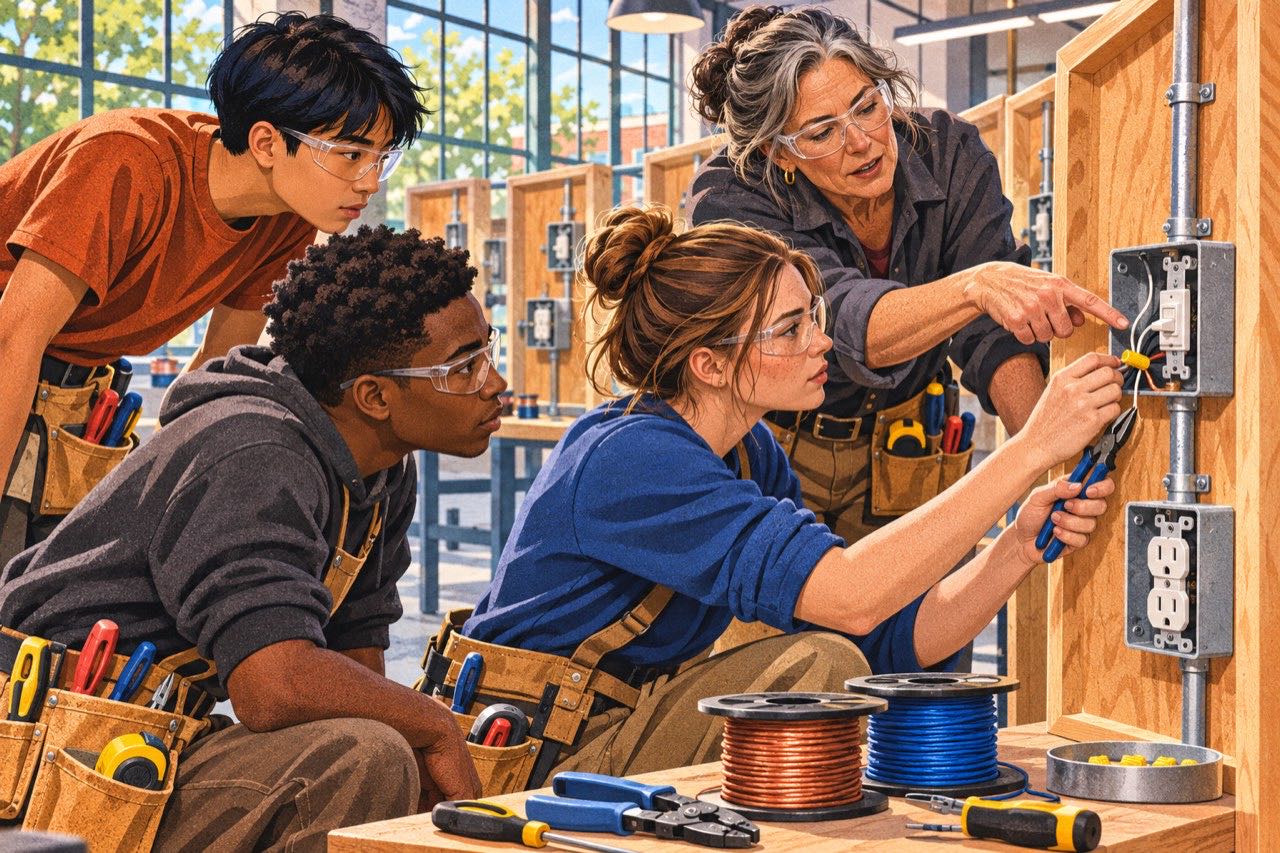
To become an electrician, you get a high school diploma or GED, get into a paid apprenticeship (union, merit-shop or employer-based), log supervised work hours while taking classes, and then pass your state or local license exam. According to the BLS, most electricians learn the trade in a 4- or 5-year apprenticeship.
Key takeaways
- Typical entry requirements: age 18, a high school diploma or GED, and one year of high school algebra (common union apprenticeship minimums).
- The BLS says apprentices typically get about 2,000 hours of paid on-the-job training each year, plus technical instruction.
- 8,000 hours of supervised work is the most common journeyman requirement in our state data; a few states ask for more.
- Trade school is optional. The BLS says graduates usually get credit toward their apprenticeship.
- Most states require a license exam on the National Electrical Code; some leave licensing to cities and counties.
- BLS median pay for electricians was $63,190 a year in May 2025. Apprentices earn less, and their pay rises as they learn.
What are the requirements to become an electrician?
The BLS lists a high school diploma or equivalent as the typical entry-level education, and apprenticeship as the usual training. You don't need electrical experience to apply. The electrical training ALLIANCE, the national training organization behind the union (IBEW–NECA) apprenticeships, says previous electrical knowledge is not required.
Each apprenticeship program sets its own minimums. The ones below are the basic requirements the electrical training ALLIANCE lists. IEC, a merit-shop association, says applicants generally must be at least 18 and must have a high school diploma or GED.
| Requirement | What it means for you |
|---|---|
| Age 18 | Minimum age listed by the electrical training ALLIANCE; IEC says applicants generally must be at least 18 |
| High school diploma or GED | The BLS says a diploma or equivalent is required; ETA also accepts a two-year associate degree or higher |
| One year of high school algebra | With a passing grade, or one post-high-school algebra course (ETA) |
| Qualifying aptitude test score | Union programs: algebra and reading comprehension |
| Drug free | Some programs also ask for a physical, background check or driver's license |
| Color vision | The BLS lists it because electricians identify wires by color |
Step by step: how do you become an electrician?
Steps 3 to 5 depend on your state. Check your state's page on our state list for the board, the hours and the exam before you start counting hours.
- 1. Finish high school or a GED, and take algebra if you haven't. Union programs ask for a transcript.
- 2. Pick a path: a union JATC apprenticeship, a merit-shop apprenticeship, a trade school program first, or a helper/trainee job with a contractor.
- 3. Register as an apprentice or trainee if your state requires it. In Texas, for example, anyone doing electrical work must be licensed, with a few exemptions, so apprentices hold a TDLR apprentice electrician license.
- 4. Log supervised hours and finish your classroom training. Keep your own record of hours from every employer.
- 5. Apply to your state (or city) and pass the journeyman exam.
Which path should you choose: union, merit shop or trade school?
All four paths can lead to a journeyman exam, state or local. The difference is how you get in, who pays for the classes, and whether your hours are tracked for you.
Union apprenticeships are run by local JATCs, the joint IBEW–NECA committees. You apply, take an aptitude test of about 2.5 hours, and the ones who qualify are interviewed and ranked. The ranked list stays active for two years. Merit-shop programs such as IEC's pair a day job with an IEC contractor with evening classes. IEC says its program takes about four years, with at least 8,000 hours of on-the-job training and 576 classroom hours, and that starting pay is typically half of a journeyman's rate.
The BLS notes that some electricians start at a technical school and usually get credit toward an apprenticeship. Some start as helpers. Some contractors run their own training programs, which are not recognized apprenticeship programs, so ask how your hours will be documented.
| Path | How you get in | Classes | Paid while learning? |
|---|---|---|---|
| Union (IBEW–NECA JATC) | Application, aptitude test, interview, ranking | Part of the program | Yes, as an apprentice employee |
| Merit shop (e.g. IEC) | Apply to a chapter program and get hired by a member contractor | Evenings; employer may help with cost (IEC) | Yes; IEC says starting pay is typically 50% of journeyman rate |
| Trade or technical school | Enroll | Full program before the job | No, while in school; credit usually counts later (BLS) |
| Helper or contractor trainee | Get hired by a contractor | Depends on employer | Yes; check that your state counts the hours |
How long does it take to become an electrician?
About four to five years for a licensed journeyman. The BLS says most electricians train in a 4- or 5-year apprenticeship, with about 2,000 hours of paid on-the-job training each year. At that pace, the common 8,000-hour requirement takes four years of full-time work.
Some states ask for more. In our state data, 25 of the 51 jurisdictions (50 states plus D.C.) list 8,000 hours. Hawaii asks for 10,000 hours over five years plus 240 hours of coursework. Arkansas and Utah list 16,000 hours for applicants without a shorter approved route. Arkansas also accepts a four-year DOL-approved apprenticeship, and Utah accepts 576 hours in an approved study program plus 6,000 apprentice hours. The BLS adds that military or construction electrical experience may qualify you for a shorter apprenticeship.
| State | Hours listed | Other routes (our state data) |
|---|---|---|
| Texas | 8,000 | Early exam option after 7,000 approved hours; license issued at 8,000 |
| Colorado | 8,000 over at least 4 years | Plus 288 classroom hours; 2,000 hours must be commercial or industrial |
| Iowa | 8,000 + 576 classroom | Two-year program + 6,000 hours, or 16,000 licensed hours with 54 CE hours |
| Washington | 8,000 | Plus 96 hours of basic classroom instruction |
| Hawaii | 10,000 (5 years) | Plus 240 hours of accepted coursework |
| Utah | 16,000 | 576-hour approved program + 6,000 apprentice hours |
| Arkansas | 16,000 (8 years) | Or a four-year DOL-approved apprenticeship |
Do you need a license to work as an electrician?
Usually, yes. The BLS says most states require electricians to pass a test and be licensed, and that the tests cover the National Electrical Code plus state and local codes. In our state data, 35 of the 51 jurisdictions issue a statewide journeyman license. South Carolina and Tennessee have only a limited state electrician credential. In places such as Illinois, New York and Pennsylvania, cities or counties do it instead.
Apprentices often need a license or registration too. Texas is a clear example: the TDLR apprentice electrician license has no exam and no experience requirement, costs $20 a year, and lets you work under the general supervision of a master electrician, journeyman electrician or residential wireman.
Where there is a state exam, it is usually open book: 29 jurisdictions in our data allow your code book, and only Rhode Island is closed book. In Texas it has 85 questions (80 scored) in 240 minutes, split into NEC Knowledge and Calculations portions, and you need 70% on each portion. Texas exams have been referenced to the 2026 NEC since September 1, 2026.
How much do electricians and apprentices make?
The BLS median pay for electricians was $63,190 a year, or $30.38 an hour, in May 2025. The lowest 10% earned less than $42,640, and the top 10% earned more than $108,510. These figures cover all electricians; the BLS doesn't break them out by license level.
The BLS doesn't publish an apprentice wage. It says apprentices earn less than fully trained electricians and that their pay increases as they learn. Electricians held about 821,000 jobs in 2025. The BLS projects 9% growth from 2025 to 2035, with about 72,700 openings a year.
| BLS measure | Figure |
|---|---|
| Median pay, May 2025 | $63,190/yr ($30.38/hr) |
| Lowest 10% | Under $42,640 |
| Highest 10% | Over $108,510 |
| Jobs, 2025 | About 821,000 |
| Projected growth, 2025–35 | 9% (about 72,700 openings a year) |
How do you get ready for the journeyman exam while you're still an apprentice?
Start a year before you're eligible. The exam rewards two skills you can practice on breaks: finding the right NEC article fast, and running the common calculations (ampacity with correction, voltage drop, box fill, dwelling load, motor circuits).
Take a free practice test with your code book open to see which topics cost you points, then work through the matching lessons. Our formulas sheet covers the math on one page.
See where you stand on the journeyman exam
Take the free 50-question journeyman practice test with your code book open. Every answer is explained and points to the NEC section to look up.
Take the free practice test →Questions
How long does it take to become an electrician?
About four to five years. The BLS says most electricians learn the trade in a 4- or 5-year apprenticeship with about 2,000 paid on-the-job hours a year. The most common state requirement before the journeyman exam is 8,000 hours, though Arkansas and Utah list 16,000 hours if you don't use an apprenticeship or approved program.
Can you become an electrician without an apprenticeship?
In some states, yes. Several states accept documented work hours under a licensed electrician instead of a registered apprenticeship. Arkansas, for example, accepts 16,000 hours of experience without one. The hours still have to be supervised and documented, so check your state's rules first.
Do I need to go to trade school to become an electrician?
No. A high school diploma or GED is the typical entry requirement, and apprenticeships include their own classroom training. The BLS says trade school graduates usually get credit toward their apprenticeship, which can help, but it isn't required.
What math do you need to become an electrician?
Union programs ask for one year of high school algebra with a passing grade, and their aptitude test includes algebra and functions. On the job and on the journeyman exam you use Ohm's law, the power formula, percentages and square roots for three-phase work.
Do apprentices get paid?
Yes. Apprenticeships are paid jobs. The BLS says apprentices earn less than fully trained electricians and their pay rises as they learn. IEC says its starting wages are typically 50% of a journeyman's rate.
Is there an exam to become an electrician?
Yes, for a journeyman license in most states. The BLS says the tests cover the National Electrical Code and state and local codes. Union apprenticeships also start with an aptitude test in algebra and reading comprehension.
Sources
- BLS Occupational Outlook Handbook: Electricians ↗ — Entry education, 4–5 year apprenticeship, 2,000 OJT hours a year, technical school credit, licensing, color vision, May 2025 pay, 2025–35 outlook
- electrical training ALLIANCE: Applying for Apprenticeship ↗ — JATC application steps, algebra and diploma minimums, aptitude test, interview, two-year ranking list
- electrical training ALLIANCE: Apprenticeship Training ↗ — Basic requirements: age 18, high school, one year of algebra, aptitude score, drug free
- IEC: Apprenticeship ↗ — About four years, 8,000 OJT and 576 classroom hours, starting pay typically 50% of journeyman rate
- TDLR: Apprentice Electrician ↗ — No exam or experience, $20, renewed annually, general supervision
- TDLR Electricians: Examination Information ↗ — Texas exam format and 2026 NEC reference (via our Texas state data)
- PSI Texas Electrician Candidate Information Bulletin ↗ — 85 questions, 240 minutes, 70% per portion
- Ohmward state requirements data (all 50 states + D.C.) ↗ — Hours and licensing structure by state, each sourced from the state board
Updated 2026-11-28. Section references are to the 2023 NEC. Ohmward is independent exam preparation, not affiliated with NFPA, any licensing board or testing company. NEC® is a registered trademark of the NFPA.