Dwelling Load Calculation: NEC Standard Method Worksheet
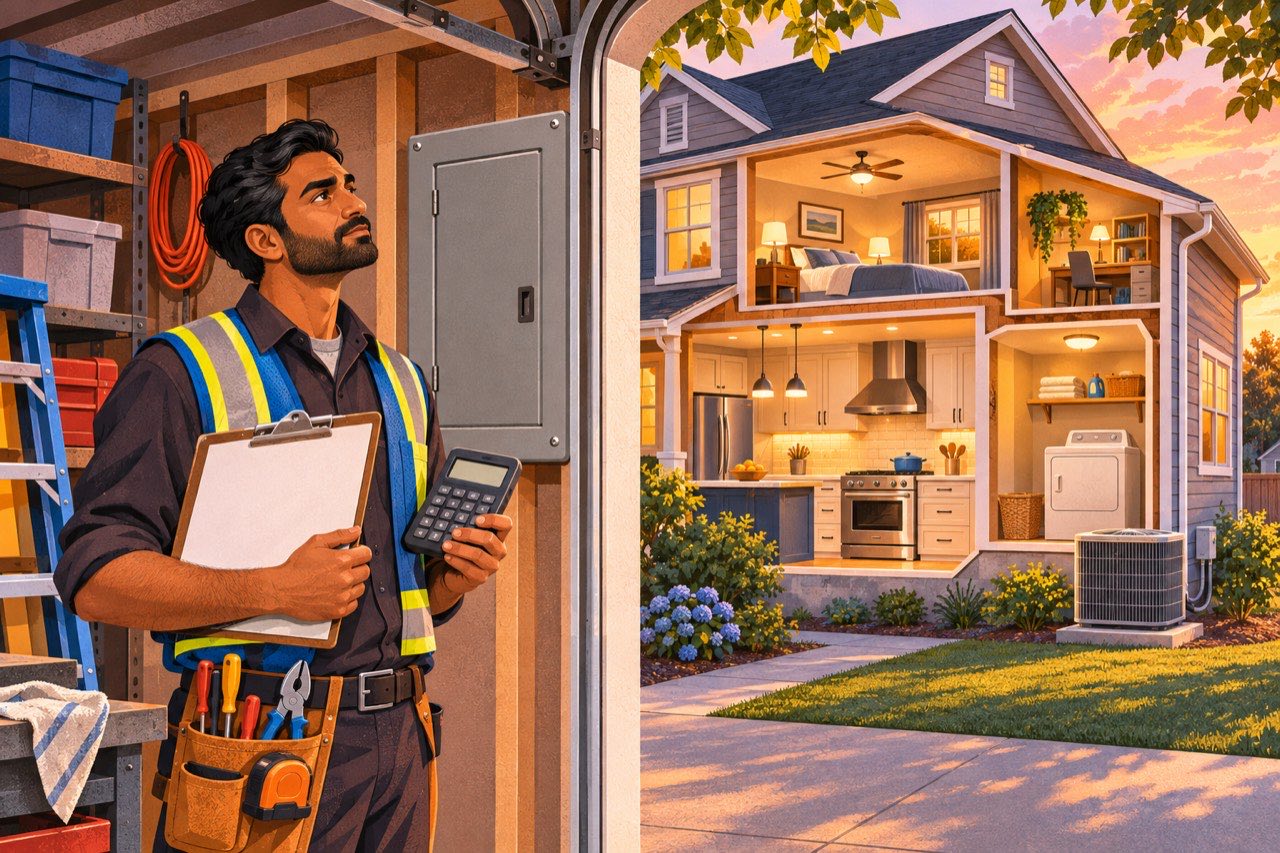
A dwelling load calculation using the NEC standard method (Article 220, Part III, 2023 NEC) adds 3 VA per square foot for general lighting, 1,500 VA for each small-appliance circuit and the laundry circuit, applies the Table 220.45 demand factors, then adds fixed appliances, the dryer, the range and the larger of heating or air conditioning. Divide the total VA by 240 V to get the minimum service or feeder ampacity.
Key takeaways
- General lighting: 3 VA per square foot of floor area (220.41, floor area per 220.5(C)).
- Add 1,500 VA for each small-appliance circuit (at least two) and 1,500 VA for laundry (220.52).
- Demand (Table 220.45): first 3,000 VA at 100 %, 3,001–120,000 VA at 35 %, the remainder at 25 %.
- Four or more fastened-in-place appliances may take a 75 % demand (220.53); a dryer is at least 5,000 VA (220.54).
- One range up to 12 kW counts as 8 kW under Table 220.55 Column C; use only the larger of heat or A/C (220.60).
- The 2026 NEC moves these load calculations to Article 120.
What is a dwelling load calculation?
A dwelling load calculation estimates the largest demand a house will put on its service or feeder, so you can size the service rating and conductors. The NEC does not assume every load runs at once. Instead, Article 220 gives fixed values and demand factors that reflect how homes really use power.
There are two ways to do it. The standard method in Part III of Article 220 works for any dwelling and is what most exam questions use. The optional method in 220.82 is a shortcut for a one-family dwelling served by 120/240 V or 208Y/120 V with conductors rated 100 A or more. This guide walks through the standard method with a complete worksheet.
Edition note: these section numbers are from the 2023 NEC. In the 2020 NEC the lighting demand table was Table 220.42, and the 2026 NEC moves load calculations into a new Article 120. Check which edition your state uses before you tab your book.
Step 1: How do you calculate the general lighting load?
Multiply the floor area by 3 VA per square foot (220.41). Measure floor area from the outside dimensions (220.5(C)). Do not include open porches or unfinished areas that can't be adapted for future use as habitable or occupiable space. Note that the 2023 NEC dropped garages from this exclusion list, so older study guides that leave out the garage are based on the 2020 or earlier wording.
Then add the small-appliance and laundry loads from 220.52: 1,500 VA for each 20 A small-appliance branch circuit serving the kitchen, pantry and dining areas (the code requires at least two), and 1,500 VA for the laundry circuit. These three loads are lumped together before the demand factor is applied.
Step 2: How do the Table 220.45 demand factors work?
Apply Table 220.45 to the combined lighting, small-appliance and laundry total. The first 3,000 VA is taken at 100 %. The portion from 3,001 to 120,000 VA is taken at 35 %. Anything over 120,000 VA is taken at 25 %. A typical house never reaches the third tier.
Example: a 2,000 ft² house has 6,000 VA of lighting plus 4,500 VA of small-appliance and laundry load, for 10,500 VA. Demand = 3,000 + (7,500 × 0.35) = 5,625 VA.
Step 3: What about appliances, the dryer, the range and HVAC?
Motors are handled too: 220.50 sends you to 430.24 through 430.26 and to 440.6 for A/C compressors, which can add 25 % of the largest motor load. Many exam house problems ignore this and simply compare A/C against heat as one block, so follow what the question gives you.
- Fixed appliances (220.53): when there are four or more appliances fastened in place on the same service or feeder, such as a water heater, dishwasher, disposal or built-in microwave, you may take 75 % of their combined nameplate load. The 2023 NEC limits this to appliances rated 1/4 hp or 500 W or more, and it never applies to ranges and other fastened cooking equipment, dryers, space heating, air conditioning or EV charging equipment.
- Dryer (220.54): use 5,000 VA or the nameplate rating, whichever is larger.
- Range (220.55): for one household range rated not over 12 kW, Column C of Table 220.55 gives a demand of 8 kW. For a range over 12 kW, Note 1 increases that 8 kW by 5 % for each kW (or major fraction) over 12 kW, for ranges up to 27 kW.
- Heating and air conditioning (220.60): these are noncoincident loads, so include only the larger one. Fixed electric space heating is taken at 100 % (220.51).
Dwelling unit load calculation worksheet: a full example
Here is a complete standard-method worksheet for a 2,400 ft² one-family house on a 120/240 V single-phase service. Fastened-in-place appliances: 4,500 W water heater, 1,200 VA dishwasher, 900 VA disposal and 1,500 VA built-in microwave. Also: a 5,500 W dryer, a 12 kW range, 10 kW of electric heat and a 4,800 VA air conditioner.
| Line | Load | Calculation | VA |
|---|---|---|---|
| 1 | General lighting (220.41) | 2,400 ft² × 3 VA | 7,200 |
| 2 | Small-appliance circuits (220.52(A)) | 2 × 1,500 VA | 3,000 |
| 3 | Laundry circuit (220.52(B)) | 1 × 1,500 VA | 1,500 |
| 4 | Subtotal lines 1–3 | 7,200 + 3,000 + 1,500 | 11,700 |
| 5 | Demand, Table 220.45 | 3,000 at 100 % + 8,700 at 35 % (3,045) | 6,045 |
| 6 | Fixed appliances, 4 or more (220.53) | 8,100 × 75 % | 6,075 |
| 7 | Dryer (220.54) | larger of 5,000 or 5,500 nameplate | 5,500 |
| 8 | Range (Table 220.55, Col. C) | one range, 12 kW | 8,000 |
| 9 | Heat vs. A/C (220.60) | larger of 10,000 or 4,800 | 10,000 |
| 10 | Total calculated load | lines 5 through 9 | 35,620 |
| 11 | Minimum ampacity | 35,620 ÷ 240 V | 148.42 A |
How do you size the service from the total?
Divide the calculated load by the system voltage. For a 120/240 V single-phase service, 35,620 VA ÷ 240 V = 148.42 A. The next standard rating in 240.6(A) at or above that is 150 A, so a 150 A service satisfies this calculation. Section 230.79(C) also sets 100 A as the minimum service disconnect rating for a one-family dwelling.
For the service-entrance conductors themselves, check 310.12 for the dwelling service conductor rules and then Table 310.16. Our ampacity lesson covers that step.
What about the neutral?
The neutral only carries the unbalanced load between the two ungrounded conductors. Loads connected line to line at 240 V, like a water heater or straight electric heat, put nothing on the neutral, so they drop out of the neutral calculation.
Section 220.61 lets you take the neutral load for household ranges and dryers at 70 % of the demand used for the ungrounded conductors. Exam questions that ask for the neutral will usually tell you which loads are 240 V only.
When can you use the optional method instead?
The optional method in 220.82 applies to a one-family dwelling (or an individual dwelling unit) with service or feeder conductors rated 100 A or more. You list the general loads at nameplate, take the first 10 kVA at 100 % and the remainder at 40 %, then add the heating and air conditioning load chosen under 220.82(C). It usually produces a smaller number than the standard method.
On the exam, read the question carefully: if it says "standard method" or doesn't specify, use the worksheet above. If it says "optional method," switch to 220.82. Existing dwellings adding load use 220.83.
Practice load calcs before exam day
Load calculation questions are long, so speed matters. Work through timed questions in the free practice test.
Take the free practice test →Questions
What is the general lighting load for a dwelling unit?
Under the 2023 NEC it is 3 VA per square foot of floor area (220.41), using the outside dimensions (220.5(C)) and excluding open porches and unfinished areas that cannot be adapted for future habitable or occupiable use. Under the 2023 NEC, garages are no longer on the exclusion list.
How many VA is a small-appliance circuit in a load calculation?
1,500 VA per small-appliance branch circuit, with at least two required. The laundry circuit is also 1,500 VA (220.52).
What demand factor applies to a dwelling dryer?
The dryer load is at least 5,000 VA or the nameplate rating, whichever is larger (220.54). Table 220.54 only reduces the load once there are five or more dryers; one to four dryers are taken at 100 %.
Do you add both heat and air conditioning?
No. Heating and cooling don't run at the same time, so 220.60 lets you include only the larger of the two.
Where is the dwelling load calculation in the 2026 NEC?
The 2026 NEC moves load calculations out of Article 220 into Article 120. Section numbers change (220.41 becomes 120.41, for example) and some values were revised, so tab and study the edition your state adopted.
What is the difference between the standard and optional method?
The standard method applies separate demand factors to each load type. The optional method in 220.82 totals general loads, takes the first 10 kVA at 100 % and the rest at 40 %, then adds heating or A/C.
Sources
- NFPA 70, National Electrical Code — code development page ↗ — official NEC edition information; section numbers are from NFPA 70-2023
- NFPA free access to codes and standards ↗ — where to read Article 220 at no cost
- Larimer County: 2023 NEC significant code changes ↗ — 2023 wording of 220.5(C) floor area: only open porches and unadaptable unfinished areas are excluded
Updated 2026-11-27. Section references are to the 2023 NEC. Ohmward is independent exam preparation, not affiliated with NFPA, any licensing board or testing company. NEC® is a registered trademark of the NFPA.